the Cancer Plan

Purpose
The Cancer Plan is a tool designed to highlight opportunities to prevent new cases of cancer, improve the treatment and ease the suffering of those with cancer, and spur community action to enact policies and regulations that decrease the cancer burden.

SOUTH CAROLINA COMPREHENSIVE CANCER CONTROL PLAN 2027–2031
Executive Summary
A Healthier South Carolina is Within Reach
Every five years, members and partners of the South Carolina Cancer Alliance (SCCA) come together to establish a shared direction for reducing the impact of cancer across the state. The South Carolina Comprehensive Cancer Control Plan 2027–2031 is South Carolina’s strategic roadmap for coordinated cancer prevention and control, translating data, community experience, and professional expertise into measurable priorities for the next five years.
Cancer in South Carolina
Cancer continues to have a significant impact on South Carolina.
SOUTH CAROLINA
441new cancer diagnoses per 100,000 residents each year, 2020–2024
SOUTH CAROLINA
151cancer deaths per 100,000 residents each year, 2020–2024
UNITED STATES
143cancer deaths per 100,000. This is the national rate, shown for comparison.
SOUTH CAROLINA
145
cancer deaths per 100,000 in 2024, down from 171 in 2015
Lung, female breast, and prostate cancers were the most frequently diagnosed cancers, and South Carolina’s cancer mortality rate remained above the national rate.
Stage at diagnosis also matters. For example, more than 41% of lung cancers were diagnosed at a distant stage (meaning the cancer had already spread), while only about 30% of lung and colorectal cancers were found at an early stage when they were still localized.
The burden of cancer is not the same for everyone. Rural residents experienced approximately 170 cancer deaths per 100,000, compared with 148 among urban residents. Non-Hispanic Black residents experienced approximately 167 cancer deaths per 100,000, compared with 150 among non-Hispanic White residents. These disparities are not confined to adults: race, ethnicity, and rurality shape cancer outcomes among pediatric patients as well.
A Plan Built Together
The 2027–2031 Plan was developed through a collaborative, data-informed process. Beginning with a Core Steering Committee, partners reviewed cancer plans from other states, assessed SCCCR, BRFSS, and program data, established multidisciplinary workgroups, and developed missions, objectives, strategies, and measures. More than 50 workgroup, partner, and follow-up meetings contributed to the process.
The 2027–2031 Plan also marks a first for the state. Pediatric cancer is named as a focal area, giving South Carolina’s youngest patients a dedicated place in the Plan’s priorities.
2027-2031 South Carolina State Cancer Plan Workgroup Structure
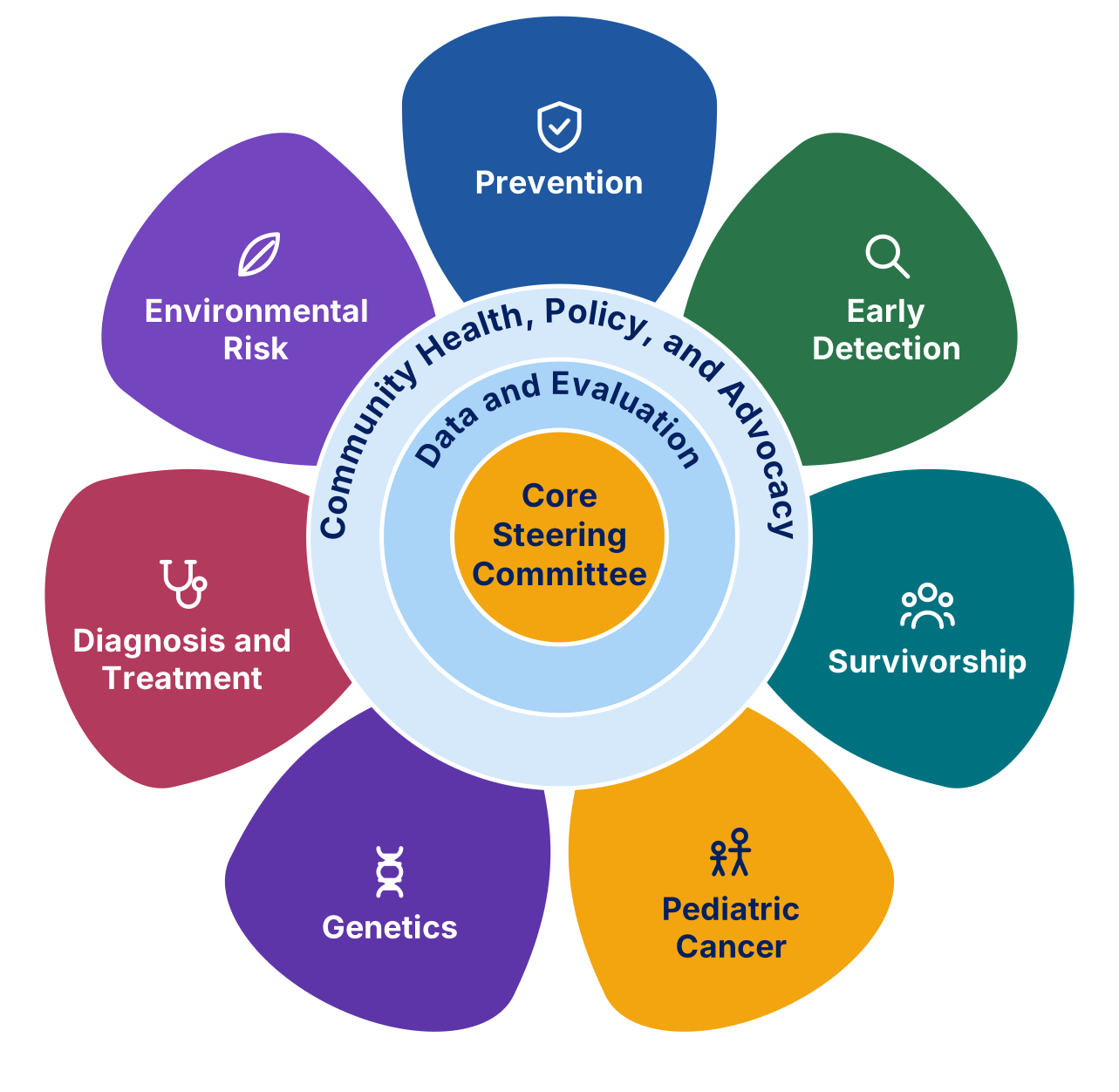
Eight topic-specific workgroups develop and carry out the Plan’s 40 objectives. Seven are shown here as petals. The eighth, Community Health, Policy, and Advocacy, is drawn as a ring rather than a petal because its scope runs across every topic area rather than alongside them. Data and Evaluation, the inner ring, is a shared function supporting all eight. At the center, the Core Steering Committee sets strategic direction and coordinates the whole.
From Priorities to Measurable Action
The Plan includes 40 objectives across eight workgroups. Objectives address prevention and risk reduction, early detection, diagnosis and treatment, navigation, survivorship, pediatric cancer, genetics, community health, policy and advocacy, and environmental risk. Several objectives initially developed as cross-cutting priorities will be adopted by the appropriate workgroups and SCCA.
How Progress Will Be Monitored
Every one of the Plan’s 40 objectives is SMART (specific, measurable, achievable, relevant, and time-bound) and includes a baseline. Progress will be monitored via:
What gets measured: three levels of measurement
Each objective includes up to three levels of measurement so that progress can be monitored routinely throughout the five years.
Implementation objectives
Are we doing what we said we would do?
Track whether planned activities, partnerships, programs, policies, and systems changes are being put into place.
Proximal objectives
Are those actions producing near-term change?
Measure earlier results such as changes in knowledge, access, screening, referrals, provider practices, participation, or use of services.
Distal objectives
Are we improving cancer outcomes over time?
Track longer-term population outcomes such as cancer incidence, stage at diagnosis, mortality, survivorship, and differences in outcomes across populations.
Together, these measures connect what partners do, what changes as a result, and whether cancer outcomes improve. Metrics were developed and finalized during the planning process.
- A public dashboard. With the full release of the Plan in February 2027, progress against the objectives becomes publicly visible and stays that way for the duration of the Plan.
- Workgroups that stay active. Each of the eight workgroups sets activities for the year ahead and reports against its own objectives.
- Statewide convenings. All-plan meetings bring every workgroup back to one table to review progress together, the first of which was held during the 2026 planning year.
- A coordinating body. SCCA tracks plan outcomes using data from the SC Central Cancer Registry, BRFSS, and partner programs, and the Core Steering Committee holds the view across all eight workgroups. Measures are being aligned with State Health Improvement Plan (SHIP) reporting.
A Data Foundation Worth Naming
The data used to guide the Plan come from the South Carolina Central Cancer Registry (SCCCR), housed within the South Carolina Department of Public Health and established by the state’s Central Cancer Registry Act of 1996. It is one of South Carolina’s strongest population health assets, and the quality of this Plan is a direct reflection of the quality of its data.
The North American Association of Central Cancer Registries awards Gold Certification as its highest standard for data quality. SCCCR has held that certification for eleven consecutive years, and has been certified Gold or Silver in every year it was eligible. The Centers for Disease Control and Prevention’s National Program of Cancer Registries has repeatedly recognized it as a Registry of Excellence. In its 2025 submission the registry reached 90% or greater twelve-month completeness, one of only twenty registries in the United States to do so.
Registry staff provided data for the SC State Plan and also advised on scope and interpretation of data. They identified patterns consequential for planning, and served on several Cancer Plan workgroups. The data will continue to guide the coalition over the next five years.
Explore South Carolina’s cancer data yourself
SC Tracking Cancer Dashboard (https://dph.sc.gov/professionals/public-health-data/sc-tracking/tracking-cancer-dashboard), from the South Carolina Department of Public Health, for county-level incidence and mortality.
SC SPOT: South Carolina Cancer Data and Statistics (https://hollingscancercenter.musc.edu/outreach/sc-spot-south-carolina-cancer-data-statistics), from the MUSC Hollings Cancer Center.
Thank You, SC Cancer Plan Chairs
Workgroup Chairs
| Workgroup | Chairs |
|---|---|
| Prevention | Dr. Marvella Ford (MUSC) and Selena Lowery (DPH) |
| Early Detection | McKenzie Speed and Macy McFarland |
| Diagnosis and Treatment | Dr. Harley Davis (Prisma) and Annie Thibault (Colorectal Cancer Prevention Network) |
| Survivorship | Whitney Wright (ReGenesis Health) and Lee Moultrie (Survivor and Advocate) |
| Genetics | Dr. Amy Messersmith (Presbyterian College) and Dr. Karen Wickersham (USC) |
| Pediatric Cancer | Dr. Anna Hoppmann (Prisma), Tessa Roberts (Prisma), and Dr. Anca Dumitriu (MUSC) |
| Community Health, Policy and Advocacy | Beth Johnson (American Cancer Society Cancer Action Network) and Karen Mace (Registry Partners) |
| Environmental Risk | Workgroup to be established; chairs to be identified |
Want to learn more or get involved?
Reach out to cancerplan@sccancer.org .
Data Sources and Attribution
Cancer incidence, mortality, and stage-at-diagnosis data are from the South Carolina Central Cancer Registry (SCCCR), South Carolina Department of Public Health, for diagnosis years 2020–2024. Rates are expressed per 100,000 population and are age-adjusted to the 2000 U.S. standard population (ages under 1 and 90 and over, Census P25-1130). Mortality figures are drawn from death certificate and vital statistics records. Behavioral risk factor data are from the Behavioral Risk Factor Surveillance System (BRFSS), Bureau of Maternal and Child Health, South Carolina Department of Public Health.
SCCCR is funded through the Centers for Disease Control and Prevention’s National Program of Cancer Registries under Cooperative Agreement CDC-RFA-DP22-2202, Cancer Prevention and Control Programs for State, Territorial, and Tribal Organizations.
The findings and conclusions in this summary are those of the South Carolina Cancer Alliance and do not necessarily represent the official position of the Centers for Disease Control and Prevention or the South Carolina Department of Public Health.
Thank You
With gratitude to the many people and organizations who gave their time, expertise, data, and experience to this Plan.
Special thanks to the SC Department of Public Health for partnership and support. We particularly acknowledge the Cancer Programs Section and the South Carolina Central Cancer Registry, both in the Bureau of Chronic Disease and Injury Prevention, and the Behavioral Risk Factor Surveillance System in the Bureau of Maternal and Child Health, for their data and content expertise.
We thank our funders and sponsors.